WHERE THE FARMHOUSE AND THE DOGHOUSE ARE ONE AND THE SAME

Tuesday, November 29, 2011

Another Working Vacation: Orchard Expansion 2011

There is nothing like fruit grown right in your own backyard (in our case, it's grown in our back-, front-, and side-yards).  I'm talking about hard cider, fresh juice, and endless fruit-filled desserts.
The fruit tree fever started in 2010.  I caught it from Ben.

Our Yellow Transparent in fruit this summer.

 Before we even moved into the house Ben planted three semi-dwarf apples: an Arkansas Black, a Cox's Orange Pippin, and a Yellow Transparent.  Those three apples were soon joined by five Brown Turkey figs.  I had absolutely no appreciation for the fig trees until this summer when I bit into the first fresh fig I had ever tasted.  I am now addicted.  Now that the Domestic Partner and I are on the same page as far as the home orchard goes, this is what we planted this month:

Apples
Arkansas Black, standard (1)
Fameuse, semi-dwarf (1)
Spitzenberg, semi-dwarf (1)
Calville Blanc D'hiver, semi-dwarf (1)
Golden Russet, semi-dwarf (1)
Northern Spy, semi-dwarf (1)
Winter Banana, semi-dwarf (1)

Peaches
Elberta, standard (2)
Hale Heaven, standard (2)
Golden Jubilee, standard (2)

Sweet Cherries
Black Tartarian, dwarf (6)
Bing, dwarf (6)

Plums
Damson, dwarf (2)

We planted ten of the cherries alongside the high tunnel and strawberries.  We have essentially replaced the old tree line (below) that we had removed before we built the high tunnel.

This is what the land looked like before the high tunnel and cherries were put in.  We've really opened up the property.

My dear Ben constructed all of the protective cages and seeded the orchard areas with winter rye.

That is how we spent the Thanksgiving Holiday.

We now have thirty-five fruit trees on our homesite, and we're already dreaming of more.  Our goal is to utilize every inch of the lawn space we have.  It's not that we necessarily need the space.  We live in a rural setting and have access to all the agricultural land we could ever need.  Our entire yard has become an orchard because of the simple fact that I HATE mowing it, and I think a pretty green lawn is a waste of space.  Our homesite is only one acre, and in addition to the orchard, it holds a kitchen garden, numerous flower beds, the chicken house and yard, a mud oven, and a dog yard.  But, there is still way too much open space to mow.  Let's just say that I think we need to welcome more four-legged creatures onto the farm...

Monday, October 31, 2011

Diatomaceous Earth to the Rescue!


One of my latest fall harvests.

Diatomaceous earth has saved the day.  Nasty little Cabbageworms were nesting in and feasting on my gorgeous broccolis and turning the leaves into lace.  I tried spraying them with neem and soap, but that wasn't the proper potion for this particular plague.

Nutri-Bud Broccoli

Several months back, we purchased several pounds of food grade DE. We planned to use it mostly in and around the hen house to keep down the population of creepy-crawlies and parasites. We were also interested in using it to help us protect our vegetable crops from pests organically. We have relied on neem oil to get us out of our (luckily, very rare) pest problems most of the time, and we wanted to find another effective weapon to add to our arsenal.

Broccoli sprinkled with DE.

DE has done an amazing job of keeping the nasties away from and out of the chickens.  We sprinkle it in their coop and around their yard right after a good cleaning.  I also add a little bit to their food from time to time as a dewormer.

A parasite-free Robert Rooster

So, you ask, what exactly is diatomaceous earth?  It's a naturally-occurring mineral compound that is made up of the fossilized remains of diatoms.  Diatoms are a hard-shelled algae.  The diatoms of which I am speaking are 30 million years old.  Totally cool.


Ready for a second harvest.

I was able to freeze several heads of the first broccoli planting, and I am looking forward to harvesting from two more plantings.

Friday, October 7, 2011

A Strawberry and High Tunnel Update

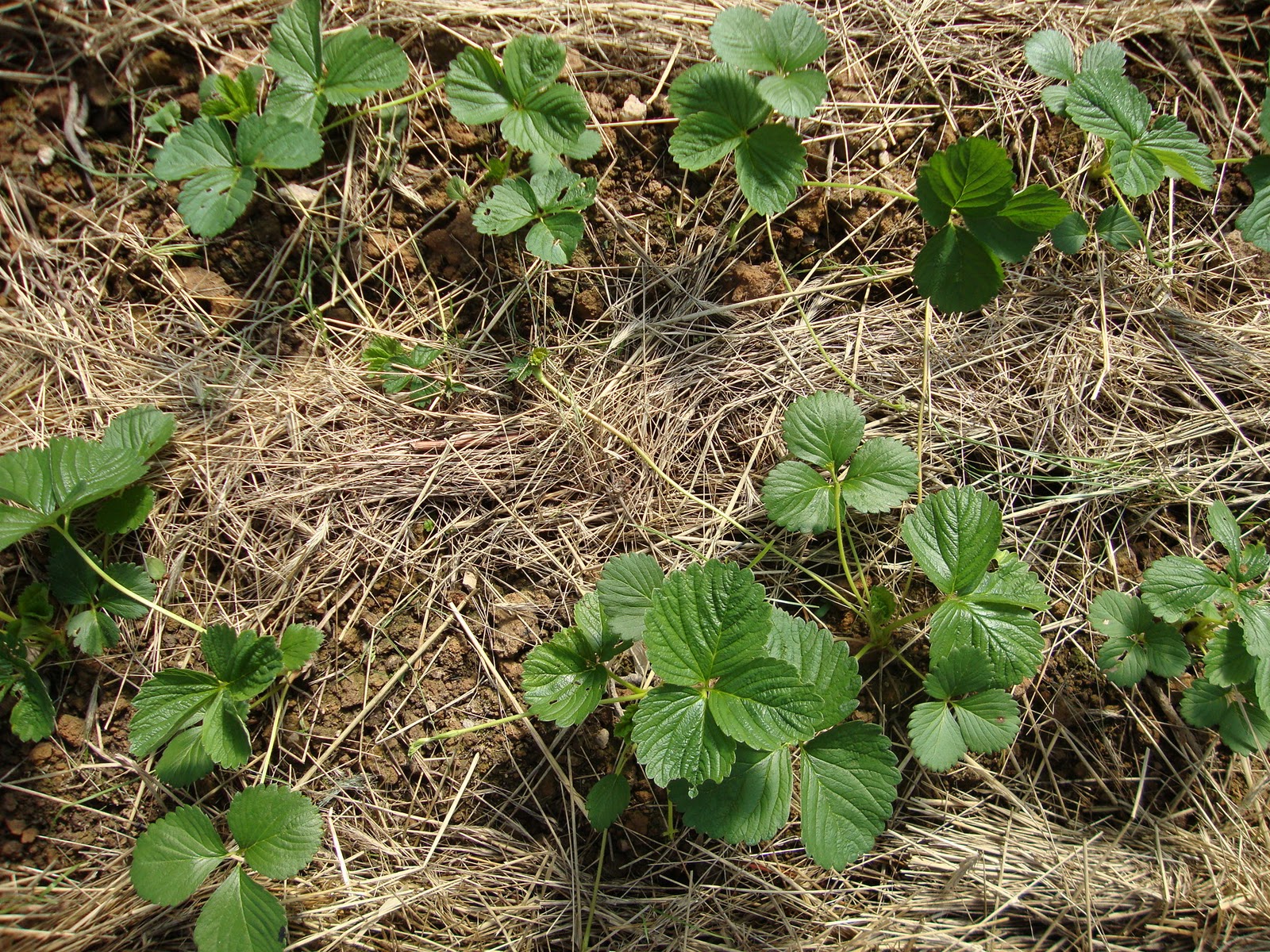
We planted our strawberries one month ago, and they've grown quite a bit since then.  I've been obsessively pinching off the flowers because the plants need time to develop before we ask them to give us a good crop.  The strawberries seem to be appreciative of the rest we're giving them.  I've also fed them with organic fish and seaweed fertilizer, and I keep them well-watered.  Lucky for us, the weather has been superb, so all is well on the strawberry front.  And, for the Mega-Bonus - I've also managed to stay on top of the weeds!

High tunnel strawberries one month ago.

High tunnel strawberries today.

One month ago.

Today.

High tunnel strawberry plant one month ago.

 High tunnel strawberry plant today.

Let's not forget the strawberries we planted outside of the high tunnel.  This is them today.

Although we were awarded a USDA grant to build the high tunnel, we've invested a lot in this project financially.  So, I'm so glad to say that there is a huge difference between the high tunnel plants and those that are outside.  I feel like I have a clear picture of what the high tunnel does for us because I have several different patches of strawberries planted around the farm.  We have them growing in front of the tunnel, in the kitchen garden, and in the greenhouse.  The strawberries are doing well in all locations, but they are growing at an insane rate under the high tunnel.  I expect that we'll get a really early crop from the high tunnel, which is our goal, exactly.

In conclusion, the Fat Bear Farm High Tunnel is kicking major butt!

Tuesday, October 4, 2011

Autumn Rituals Revisited

First of all, you need some good company when raking leaves.  Enter, Miles Giles.  Not only did he keep me company on this gorgeous fall day, but he also managed to stay out of the way.  It's a lot to ask of a 2-year-old pup to stay out of piles and piles of freshly-raked leaves.  I think he was too interested in all the autumn preparations being made by nearby creatures readying themselves for a long winter.  The deer, rabbits, squirrels, and birds have been working tirelessly collecting nuts, berries, and whatever-the-hell-else they need to survive until spring.

 "I smell a rabbit!"

 "Do you smell that rabbit?"

"Hold on, I think I smell another rabbit!"

The big poplar pictured below gives us a ton of leaves, and we have a million other trees in the yard, but I'll need more than they can provide.  I know I'll need several loads of leaves to cover beds in the kitchen garden, and I also want to put leaves in the chicken yard throughout the season.  Dry leaves give the birds something to scratch around in, and they love hunting around for all the bugs in there.

Can you find Miles?

My best next-door neighbor was kind enough to grant me permission to rake up all of his leaves this autumn, free of charge!  This might not sound like a big deal, but believe me, it is.  My neighbor takes immaculate care of his yard and garden.  He meticulously rakes his leaves as soon as they hit the ground, and he has a lot of trees.  This neighbor adds his leaves to his compost pile, mulches his beds with them, and so on.  He uses each and every leaf.

Unfortunately, Mr. Best Neighbor in the World will be wintering in Florida.  Fortunately, however, I landed this year's rights to his fallen leaves!

One batch ready for the chicken yard.

All of today's leaves got moved into the chicken yard.  The easiest way to get them there is to rake them onto a big tarp and drag them.  I don't bother spreading them around, I suffer from allergies enough as it is.  I just dump them in big piles, and the girls get busy and move them where they want them.  

I take care of the collection and transportation of the leaves.  The chickens do all of the distribution.  By tomorrow their entire yard will be evenly covered in leaves, and I mean perfectly evenly covered.


Here, I have an empty garden bed.  It's the only empty bed in my entire kitchen garden right now.  Woo-hoo, fall garden!  Anyway, I am going to put this bed to bed.

Stripped-down bed, all hoed-up.

I have asked a lot from this bed.  It has grown garlic, beets, peppers and corn, and it has done this non-stop for a full year.  So, it needs some TLC.  I started out by giving it a good hoe.  Next, I dumped a few gallons of vermicompost on top.

Ben intentionally left some worms in this batch of vermicompost.  They'll do us some good in the garden.

These guys get to try their luck living on the outside.  Will they succumb to drought?  Will they become a bird's prey?  Or, will they get hacked by a shovel?...

I just dumped them out in one big pile.  I don't spread them out.  The worms work themselves into the ground at their own speed, and they spread themselves out down there.  They actually are a lot better off if you just leave it up to them.

A big pile of worm poop.

Immediately after I put down the vermicompost, I threw on a layer of old chicken bedding.  Conveniently, I just cleaned out their coop this morning, so I had a good load of chicken poop and straw.  No, this hasn't been composted, but that's not a problem.  The chickens spend so much time running and playing outside that they don't poop a ton in their house.  So, there isn't an awful lot of poo in the straw.  Also, this bed will sit here for at least five months.  During this time, I'll add some leaves, grass clippings, compost, and whatever other good organic matter I have around.  Lots of sexy composting action will happen right on top of this bed.

I like seeing random feathers in the mulch.  It reminds me that chickens are great garden helpers.

There are many more autumn rituals to be performed.  I'll soon be weed-eating and mulching around the blueberry bushes, planting fruit trees, fertilizing and mulching asparagus, and a multitude of other things. I feel like a busy little squirrel, myself.

Wednesday, September 28, 2011

Still Going Strong: Summer's Hangers-On

The kitchen garden no longer looks like this:


Gone are the squash, sweet corn, and melons.  But a few summer favorites are still around.  This post is in appreciation of all those hot-weather plants that have yet to say goodbye.


Dear Eggplant,
We've come a long way together.  We fought and won two major flea beetle invasions, and I think we are both stronger from that epic battle.  You've given us countless meals this summer, and I can't thank you enough for that.  The eggplant parmesan pizza was incredible!  We will soon say goodbye, but don't worry, you won't be gone for long.  I'll be sowing your seeds again in just six months, and you'll be coming back ten times over.  We're putting up a mini-high tunnel for you!  You'll have a warmer home, not quite so exposed to flea beetles.  The weather will be warmer under the tunnel, so you can come out earlier, and hopefully, you'll stay longer.  We will miss you terribly this winter, as you are neither pickled nor frozen.
Pingtung Long eggplant this week.


Dear Peppers,
Your persistence is amazing.  You have real stick-to-itiveness!  I am particularly looking forward to enjoying the roasted reds I have waiting in the freezer.  Also, the chili powder from the Anchos will be great for all the veggie chili I'll make this winter.  It's been a good run.
They're still ripening beautifully.

This week's pepper harvest.


Dear Tomatoes,
After the first blight, I thought I had lost you forever.  I was wrong.  You came back for rounds two and three.  I'm so happy you're still in my life for fresh eating daily, but you will also be joining us at the table throughout the cold months as frozen and canned delights. A sincere thanks to you all (Black Sea Man, Black Plum Paste, Moonglow, Persimmon, Red Brandywine, Speckled Roman, Wisconsin 55, and Mystery Compost Pile tomatoes).
Some of the latest tomatoes; Mystery Compost Pile in the background, Black Plum Paste in the foreground.

It's a joy to have our fall garden in the ground while summer's plants are still feeding us.  I can't remember a time when we've run out of veggies around here.