WHERE THE FARMHOUSE AND THE DOGHOUSE ARE ONE AND THE SAME

Thursday, December 29, 2011

Hiatus


We're all taking a bit of a breather here.  I'll spare you from the doldrums of our winter chores.  The greenhouse will be up and running again in a couple months.  
See you in 2012!

Thursday, December 1, 2011

Asparagus: The Annual Disappearing Act

It's not that the work slows down in autumn, it's just that the type of work changes.  There's a lot of clean-up, mulching, pruning, and general putting-to-rest to do.  

Winter is on its way, but there's still no time to play.

At the moment, my focus is on asparagus.  The ferns have yellowed and died.  This means that the plants have made all food they can to support the root systems, so I can now cut them back.  This task is a much bigger undertaking than it was last fall.  We have twice as much asparagus growing now, so the work has doubled.


I have to cut them back for several reasons.  First of all, the ferns can harbor pests and diseases.  In our case, I've found quite a few slugs attached to the bases of the stems.  This is a plus for the chickens.  I like to throw them a few asparagus tops here and there so that they can enjoy the slimy snacks.  They tend to leave the actual ferns alone.  Secondly, it's a lot easier to mulch the rows with the ferns out of the way.  Mulching is extremely important in the fall.  It protects the crowns from heaving out of the ground as it freezes and warms, and it suppresses the early spring weeds.  And finally, if I were to let the ferns remain, they would shade out and slow down the emergence of new spears in the spring.


Although this job is long and tedious, it is very satisfying work.  When I'm all done, the asparagus field will look like nothing more than rows of golden straw.  It will all be weeded, mulched, and prepped for spring's arrival.


Tuesday, November 29, 2011

Another Working Vacation: Orchard Expansion 2011

There is nothing like fruit grown right in your own backyard (in our case, it's grown in our back-, front-, and side-yards).  I'm talking about hard cider, fresh juice, and endless fruit-filled desserts.
The fruit tree fever started in 2010.  I caught it from Ben.

Our Yellow Transparent in fruit this summer.

 Before we even moved into the house Ben planted three semi-dwarf apples: an Arkansas Black, a Cox's Orange Pippin, and a Yellow Transparent.  Those three apples were soon joined by five Brown Turkey figs.  I had absolutely no appreciation for the fig trees until this summer when I bit into the first fresh fig I had ever tasted.  I am now addicted.  Now that the Domestic Partner and I are on the same page as far as the home orchard goes, this is what we planted this month:

Apples
Arkansas Black, standard (1)
Fameuse, semi-dwarf (1)
Spitzenberg, semi-dwarf (1)
Calville Blanc D'hiver, semi-dwarf (1)
Golden Russet, semi-dwarf (1)
Northern Spy, semi-dwarf (1)
Winter Banana, semi-dwarf (1)

Peaches
Elberta, standard (2)
Hale Heaven, standard (2)
Golden Jubilee, standard (2)

Sweet Cherries
Black Tartarian, dwarf (6)
Bing, dwarf (6)

Plums
Damson, dwarf (2)

We planted ten of the cherries alongside the high tunnel and strawberries.  We have essentially replaced the old tree line (below) that we had removed before we built the high tunnel.

This is what the land looked like before the high tunnel and cherries were put in.  We've really opened up the property.

My dear Ben constructed all of the protective cages and seeded the orchard areas with winter rye.

That is how we spent the Thanksgiving Holiday.

We now have thirty-five fruit trees on our homesite, and we're already dreaming of more.  Our goal is to utilize every inch of the lawn space we have.  It's not that we necessarily need the space.  We live in a rural setting and have access to all the agricultural land we could ever need.  Our entire yard has become an orchard because of the simple fact that I HATE mowing it, and I think a pretty green lawn is a waste of space.  Our homesite is only one acre, and in addition to the orchard, it holds a kitchen garden, numerous flower beds, the chicken house and yard, a mud oven, and a dog yard.  But, there is still way too much open space to mow.  Let's just say that I think we need to welcome more four-legged creatures onto the farm...

Monday, October 31, 2011

Diatomaceous Earth to the Rescue!


One of my latest fall harvests.

Diatomaceous earth has saved the day.  Nasty little Cabbageworms were nesting in and feasting on my gorgeous broccolis and turning the leaves into lace.  I tried spraying them with neem and soap, but that wasn't the proper potion for this particular plague.

Nutri-Bud Broccoli

Several months back, we purchased several pounds of food grade DE. We planned to use it mostly in and around the hen house to keep down the population of creepy-crawlies and parasites. We were also interested in using it to help us protect our vegetable crops from pests organically. We have relied on neem oil to get us out of our (luckily, very rare) pest problems most of the time, and we wanted to find another effective weapon to add to our arsenal.

Broccoli sprinkled with DE.

DE has done an amazing job of keeping the nasties away from and out of the chickens.  We sprinkle it in their coop and around their yard right after a good cleaning.  I also add a little bit to their food from time to time as a dewormer.

A parasite-free Robert Rooster

So, you ask, what exactly is diatomaceous earth?  It's a naturally-occurring mineral compound that is made up of the fossilized remains of diatoms.  Diatoms are a hard-shelled algae.  The diatoms of which I am speaking are 30 million years old.  Totally cool.


Ready for a second harvest.

I was able to freeze several heads of the first broccoli planting, and I am looking forward to harvesting from two more plantings.

Friday, October 7, 2011

A Strawberry and High Tunnel Update

We planted our strawberries one month ago, and they've grown quite a bit since then.  I've been obsessively pinching off the flowers because the plants need time to develop before we ask them to give us a good crop.  The strawberries seem to be appreciative of the rest we're giving them.  I've also fed them with organic fish and seaweed fertilizer, and I keep them well-watered.  Lucky for us, the weather has been superb, so all is well on the strawberry front.  And, for the Mega-Bonus - I've also managed to stay on top of the weeds!

High tunnel strawberries one month ago.

High tunnel strawberries today.

One month ago.

Today.

High tunnel strawberry plant one month ago.

 High tunnel strawberry plant today.

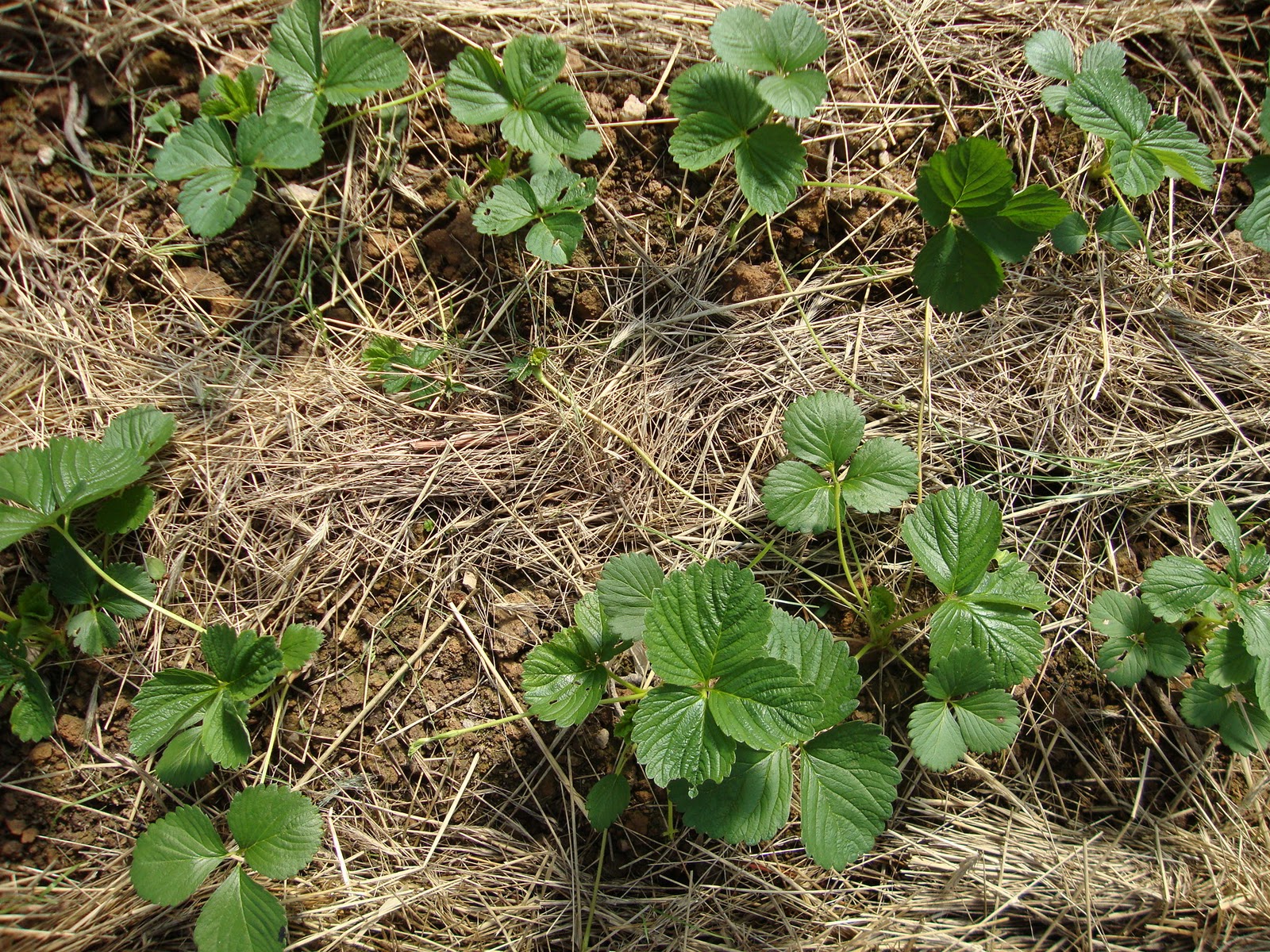
Let's not forget the strawberries we planted outside of the high tunnel.  This is them today.

Although we were awarded a USDA grant to build the high tunnel, we've invested a lot in this project financially.  So, I'm so glad to say that there is a huge difference between the high tunnel plants and those that are outside.  I feel like I have a clear picture of what the high tunnel does for us because I have several different patches of strawberries planted around the farm.  We have them growing in front of the tunnel, in the kitchen garden, and in the greenhouse.  The strawberries are doing well in all locations, but they are growing at an insane rate under the high tunnel.  I expect that we'll get a really early crop from the high tunnel, which is our goal, exactly.

In conclusion, the Fat Bear Farm High Tunnel is kicking major butt!